AI Music Generator is easy to misunderstand at first. Many people still approach music creation as if the hardest part is access to software, instruments, or technical skill. In my observation, the more difficult problem often appears earlier. It starts when someone has a mood in mind, a scene in mind, or even a line of lyrics in mind, but cannot yet hear the structure that would make it real. That gap between intention and sound is where many ideas quietly disappear. A platform like ToMusic AI becomes interesting not because it replaces musical ambition, but because it shortens the distance between vague intention and an audible first version.
This matters because unfinished ideas rarely fail on quality alone. They fail on momentum. A creator may know the emotional tone they want, yet still spend too long deciding whether the track should be melodic or sparse, vocal or instrumental, intimate or cinematic. By the time the structure becomes clear, the original impulse may already be gone. What I find notable about ToMusic AI is that it frames music generation as a language-first process. Instead of beginning with a traditional production environment, it begins with text, lyrics, mood, style, and lightweight control. That shifts the first decision from technical assembly to creative direction.
Why Language First Creation Feels More Natural
For many non-producers, the most honest way to describe music is not through theory. It is through adjectives, references, and emotional intent. People say they want something warm, tense, spacious, nostalgic, bright, nocturnal, playful, or dramatic. They describe instruments, pacing, or atmosphere long before they think in terms of arrangement logic. ToMusic AI seems built around that reality.
Prompting Starts Where Human Ideas Usually Start
On the generator page, the interface begins with a straightforward structure: title, style input, lyric input, instrumental mode, and visible tags for genre, moods, voices, and tempos. That feels important because it reflects how many users actually think. They are not forced to enter a technical production mindset before hearing a result. They can start from intent.
Lyrics Become Direction Rather Than Decoration
The platform also supports lyric-based generation, which changes the role of words. Lyrics are no longer something added late, after composition is mostly complete. They can become part of the structural starting point. In practice, that makes songwriting more accessible to people whose strongest asset is verbal imagination rather than audio engineering confidence.
Musical Control Stays Simple Without Feeling Empty
In my testing mindset, simplicity only works when it still leaves room for meaningful control. ToMusic AI does not seem to present endless menus for the sake of complexity. Instead, it keeps the input logic close to things a creator can actually describe: genre, mood, voice direction, tempo, and lyrics. That makes the system easier to approach without making the creative act feel trivial.
What The Official Workflow Actually Looks Like
One reason this platform is usable is that the core flow is short. It does not ask the user to move through a long production chain before hearing anything.
Step One Shapes The Creative Intent Clearly
The first step is to enter what the platform asks for directly on the generator page: a title, style description, optional lyrics, and whether the result should be instrumental. This is the point where good output likely depends on specificity. A weak prompt probably leads to a generic result. A clearer prompt gives the model stronger guidance.
Step Two Narrows The Musical Direction
The visible style controls then help refine the request with tags such as genre, mood, voice, and tempo. This matters because many prompts are emotionally rich but structurally vague. These controls appear to reduce that vagueness without demanding technical expertise.
Step Three Triggers The Actual Generation
After the input and direction are set, the user clicks Generate Music. From there, the platform turns the written idea into a song or instrumental result. The process is positioned as fast, which makes sense for users who want multiple creative passes rather than one overly precious draft.
Step Four Moves Results Into Ongoing Use
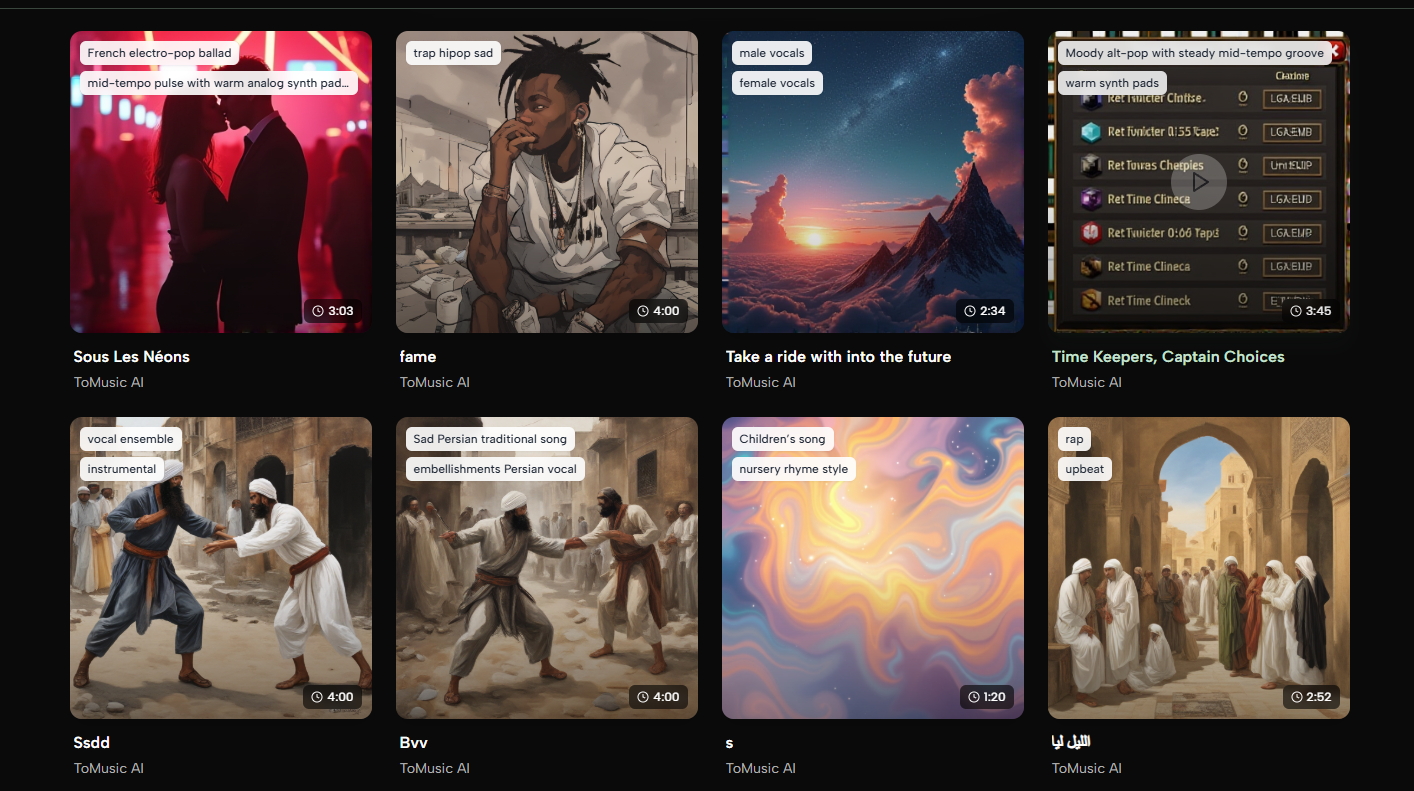
The generated work is then organized through My Music Studio or the wider library structure referenced across the site. That may sound like a minor detail, but it is actually part of the workflow logic. Fast generation only becomes useful when earlier versions remain easy to revisit, compare, and reuse.
Why Multiple Models Change Creative Expectations
One of the clearest differentiators on the site is the presence of multiple models rather than a single universal engine. In theory, this matters more than marketing language suggests.
Different Models Encourage Different Kinds Of Drafting
The site describes four available models: V4, V3, V2, and V1. According to the platform’s own explanation, these models are not just minor updates in a sequence. They are positioned with distinct strengths, such as vocal expression, harmonic richness, extended composition length, or balanced ease of use.
V4 Pushes Toward Vocal Expression And Control
If a creator cares most about expressive singing or wants stronger control over the emotional result, V4 appears to be the model the platform wants users to consider first.
V3 Seems Better For Harmonic Texture
For more layered harmony or pattern richness, V3 is framed as a stronger option. That makes sense for users who care about musical density more than pure vocal realism.
V2 Extends Time More Comfortably
The site mentions longer compositions through V2, including extended durations. That can matter for ambient work, cinematic ideas, or projects that need longer-running structure.
V1 Keeps The Experience More Balanced
V1 looks like the simpler, more balanced entry point. That may be useful when speed and predictability matter more than experimentation.
Where Text to Music Becomes Most Useful
The second anchor point in this discussion is Text to Music. I think this phrase matters because it describes more than a technical conversion. It points to a shift in how users treat music creation itself. Instead of viewing music as something that must begin in a DAW, the user can begin in language and reach audio much earlier.
This is especially valuable for creators who work in adjacent fields. A short-form video editor, ad strategist, game prototyper, teacher, or solo founder may not need to become a full-time composer. They may need fast access to music that matches a specific communication goal. In that context, text-led generation is less about novelty and more about operational speed.
A Better Tool For Directional Experimentation
What makes these platforms worth using is often not the first output. It is the ability to compare directions quickly.
Iteration Is Part Of The Real Creative Product
The site explicitly notes that if you do not like the result, you can generate again, adjust the prompt, try another model, refine lyrics, or add more detailed style tags. That is one of the more credible parts of the platform. Good creative systems rarely work because they are perfect on the first pass. They work because iteration is cheap enough that exploration becomes practical.
Variation Reduces The Fear Of Choosing Wrong
When the cost of drafting is low, people become less defensive and more exploratory. They test a brighter chorus, a slower tempo, a different vocal posture, or a purely instrumental version. In my observation, this changes behavior in a useful way. Users spend less time protecting one fragile idea and more time discovering what the idea could become.
A Practical Comparison Of What Matters Most
|
Aspect
|
What ToMusic AI Emphasizes
|
Why It Matters In Practice
|
|
Input method
|
Text prompts, styles, lyrics
|
Lowers entry barrier for non-producers
|
|
Mode options
|
Instrumental or lyric-based songs
|
Supports both background music and full songs
|
|
Direction controls
|
Genre, mood, voice, tempo
|
Helps users move from vague idea to clearer output
|
|
Model choice
|
V1, V2, V3, V4
|
Lets different projects favor different strengths
|
|
Iteration path
|
Generate again with refinements
|
Makes experimentation realistic
|
|
Usage scope
|
Personal and commercial use cases
|
Useful for creators beyond hobby music making
|
Why Commercial Use Changes The Value Equation
The platform also highlights royalty-free and commercial usage positioning. That matters because a music tool becomes more valuable when it can move beyond experimentation into publishable work. A creator making social clips, ad drafts, branded explainers, podcasts, or internal product demos may care less about abstract music innovation and more about whether a track can be used confidently in real output.
Speed Matters More When Work Has Deadlines
A musician may tolerate long drafting cycles for artistic reasons. A marketing team often cannot. A content creator posting daily often cannot. A game prototype often cannot. When music generation sits inside a deadline-driven workflow, speed is not a luxury. It is the feature that makes the rest of the platform relevant.
Creative Independence Also Has Operational Value
There is another practical advantage here. Small teams often do not lack taste. They lack bandwidth. A text-led music workflow can reduce dependence on external back-and-forth for early-stage drafts. That does not eliminate the value of skilled composers, but it does change which tasks require them.
The Limits Are Real And Worth Saying Clearly
A useful review should not pretend these tools solve everything. They do not.
Results Still Depend On Prompt Quality
If the input is vague, the result may also feel vague. Saying “make something cool” is unlikely to produce a track with strong identity. The tool can accelerate decision-making, but it cannot fully replace decision-making.
Multiple Generations May Still Be Necessary
Even with strong inputs, the first result may not be the right one. In my view, that is normal rather than disappointing. The platform seems most valuable when treated as an iterative environment, not a one-click miracle.
Taste Remains A Human Responsibility
The platform can generate music. It cannot fully decide what your project should emotionally communicate. The more intentional the user is, the better the system is likely to serve them.
Why This Shift Matters Beyond Music Alone
The most interesting thing about ToMusic AI may not be that it generates songs. It may be that it reframes the opening move of music creation. The user starts with language, intent, and direction, hears a draft quickly, and then refines from there. That is a meaningful structural change.
For people who already produce music traditionally, the platform may function as a sketch engine, ideation partner, or fast testing layer. For people outside music production, it may function as an entry point that makes sound feel available rather than distant. In both cases, the deeper value is not simply automation. It is the reduction of friction between imagination and audible form.
That is why I think platforms like this deserve attention. Not because they make every user a finished composer overnight, and not because every result will be exceptional, but because they give more ideas a chance to survive long enough to become something worth shaping.