Most brands and creators are sitting on hundreds of images that have already done their job once and then gone quiet. Product shots from a catalog shoot two seasons ago. Event photos that ran as a single carousel. Portraits, food plates, storefronts, travel frames. They cost real money or real effort to make, and they now live in a folder while every platform in the feed rewards motion over stillness. The gap between those two facts is the whole reason people are learning to convert picture to video rather than commissioning yet another shoot they cannot afford.
This is less a technology story than an asset story. The question is not whether a still can be made to move, since it plainly can. The question is which of your pictures are worth moving, what changes when they do, and how to run that at a pace that fits a real content calendar.
Why a Still Photo Beats a Blank Prompt as a Starting Point
There is a meaningful difference between describing a scene from nothing and moving a scene you already have. A written prompt asks the model to invent the subject, the setting, the light, and the motion all at once, and it will happily invent a slightly different version each run. A photo removes most of that guesswork. The subject is fixed, the lighting is fixed, the composition is already approved by a human being. The model’s only remaining job is movement.
That single constraint is why picture-led generation tends to be the steadier path. You get consistency for free, because the source frame anchors the result. For anyone whose brand has a look worth protecting, that is not a small advantage, it is the entire argument.
Which Pictures Actually Convert Well, and Which Fight Back
Not every image in your archive deserves a video treatment, and knowing the difference saves an enormous amount of wasted generation.
Photos That Reward the Effort
Clean product shots on uncluttered backgrounds, portraits with a clear single subject, landscapes and scenery with natural ambient movement, and food or lifestyle frames where a curl of steam or a slow drift adds plausible life. What these share is a clear subject and room around it, which gives the model an unambiguous thing to hold onto.
The Clean-Anchor Rule Worth Following
A sharp, well-lit picture with one obvious subject produces stable motion far more often than a busy frame does, so the picture you choose matters more than the prompt you write.
Photos That Tend to Struggle
Crowded group shots, images dense with fine text or intricate patterns, low-light frames with mushy edges, and compositions where several subjects compete for attention. These give the model too many ambiguous edges to track, and ambiguity is where warping starts.
When Cropping Beats Rewriting the Prompt
Trimming distractions out of a frame before you upload it routinely improves a result more than any clever phrasing, because you are removing the problem rather than describing around it.
Turning One Photo Into Several Usable Clips
The real leverage arrives when you stop thinking of the conversion as one-to-one. A single product still can become a slow push-in for a hero placement, a subtle ambient loop for a background, and a vertical crop with a different movement for a story slot. Because you are working from the same anchor image, all three stay visually consistent with each other and with the campaign they came from.
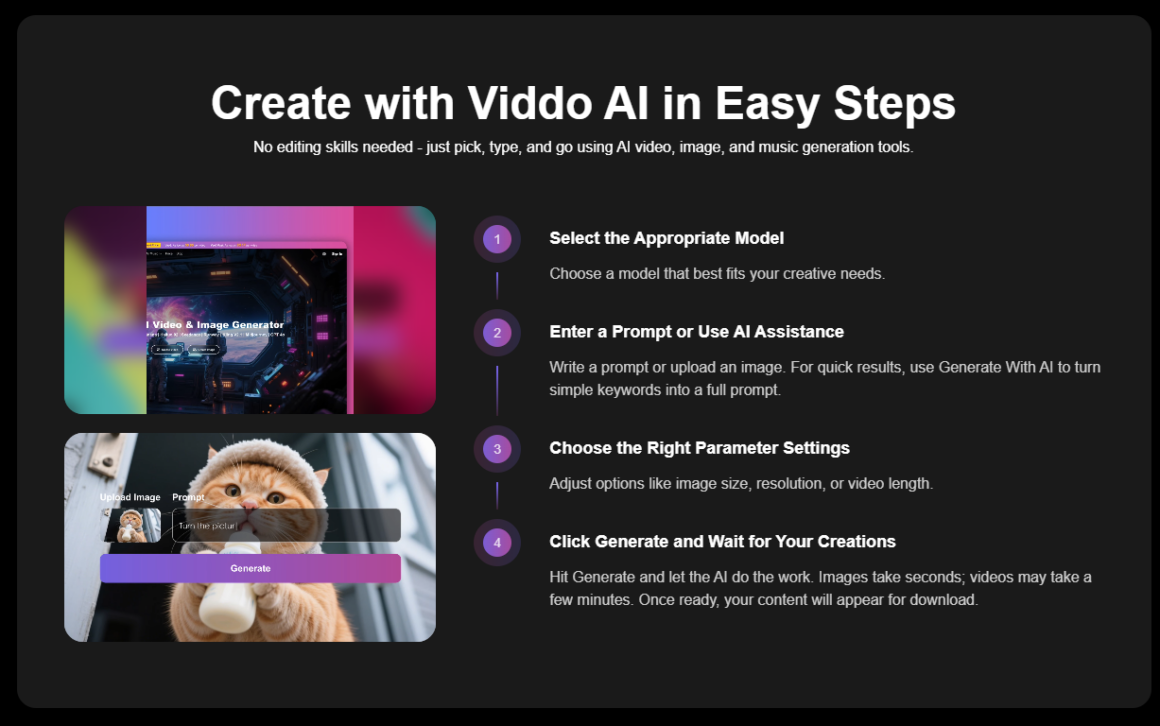
This is where the tooling matters. Inside Viddo AI you can convert picture to video using different underlying models on the very same still, which is useful precisely because engines interpret motion differently. One may hold the label edges cleanly while another gives the frame livelier movement, and having both within one workspace lets you pick per placement rather than per subscription. One design detail shapes how you write here: Viddo AI passes your prompt straight through to whichever model you choose rather than converting it into a shared house syntax, so the phrasing that suits one engine may need a small adjustment on another. That is a modest cost for staying close to each model’s native behavior.
The On-Screen Steps From Archive Photo to Finished Clip
The path from a folder of stills to a posted clip is short enough to run inside a normal working day.
Upload the Still and Choose Your Model
You begin by bringing in a JPG or PNG and selecting which model will handle it, starting from a picture you already own rather than a blank page.
Letting the Hard Part of the Shot Pick the Engine
If the difficult element is a face, a label, or a fast turnaround, naming that first turns model selection into a decision rather than a coin flip.
Describe the Motion You Want Added
Next you write a prompt stating the movement, and you can lean on the built-in assistance to expand a short phrase into fuller direction.
Naming the Movement Instead of Stacking Adjectives
A slow push-in, a gentle pan, rising steam, a soft head turn: concrete motion cues steady results far more than words like dynamic, which models read loosely.
Set the Format, Then Generate and Extend
Before running you set aspect ratio, resolution, and duration to suit the placement, then generate and, if the draft earns it, extend the clip into a longer sequence.
Judging the First Draft Before Building on It
Extending a clip that already feels wrong multiplies the flaw, so an honest look at the first result is the cheapest quality control you have.
Photo-Led Video Compared With Filming or Prompting
|
Dimension
|
Converting a photo you own
|
Prompting a scene from text
|
Filming new footage
|
|
Starting asset
|
Already exists and is approved
|
Invented fresh each run
|
Must be shot
|
|
Brand consistency
|
Anchored to your own image
|
Can drift between attempts
|
Fully controlled
|
|
Turnaround
|
Minutes per clip
|
Minutes, with more iteration
|
Days to weeks
|
|
Cost profile
|
Reuses sunk photo spend
|
Low, but exploratory
|
Crew, time, and budget
|
|
Best fit
|
Archives worth reactivating
|
Scenes you cannot capture
|
Footage that must be real
|
Where This Fits in a Real Content Operation
The teams getting the most from this are not the ones chasing spectacle. They are e-commerce sellers giving old product photos a second commercial life, social creators adding movement to a still that already performed well, and small marketing teams that need a steady cadence of motion without booking a shoot every month. If your work demands elaborate choreography or footage that must be provably real, a camera still wins. But if there is a folder on your drive full of pictures you paid for and used once, the fastest video you will make this quarter is probably already in it.